Discipline vs. Motivation
Why Consistency Wins Long After Motivation Fades

Introduction: The Motivation Myth
Most parents fail not because they lack willpower, but because they rely on a volatile fuel source: Motivation. Motivation is a feeling—a neurochemical spike of dopamine usually triggered by a New Year’s resolution, a tight pair of jeans, or a doctor’s warning. But feelings are fickle. They are affected by a poor night’s sleep, a stressful meeting, or a sick toddler. If your fitness plan requires you to “feel like it,” you have already built your foundation on sand.
This article explores why Consistency—the disciplined adherence to a system regardless of emotional state—is the only path to long-term health, and how busy parents can build it.
I. The Neurobiology of the “Motivation Gap”
To understand why consistency wins, we must look at the brain. Motivation is primarily driven by the Nucleus Accumbens, the part of the brain responsible for the reward circuit. It’s the “gas pedal.”
However, the “steering wheel” and “brakes” are located in the Prefrontal Cortex. This is the area responsible for executive function and long-term planning.
1. The Cost of Decision Fatigue
As a parent, you make thousands of decisions daily. What should the kids eat? Is the laundry done? Did I answer that email? By 6:00 PM, your Prefrontal Cortex is exhausted. This is called Decision Fatigue. * Motivation requires a decision: “Should I work out now?”
Consistency removes the decision: “It is 6:00 PM; I work out now.”
When you rely on consistency, you bypass the exhausted part of your brain and rely on the Basal Ganglia—the seat of habit—which requires almost zero mental energy to activate.
II. The Architecture of Consistency: Systems Over Goals
In his book Atomic Habits, James Clear famously noted, “You do not rise to the level of your goals. You fall to the level of your systems.” For the busy parent, the “system” is the only thing that survives the chaos of family life.
1. The Minimum Viable Effort (MVE)
The biggest enemy of consistency is the “All or Nothing” mentality. Most parents think if they can’t do a 60-minute gym session, the day is a wash. The Authoritative Shift: You must define your “Floor,” not just your “Ceiling.”
The Ceiling: A 60-minute heavy lifting session.
The Floor (MVE): 10 minutes of kettlebell swings in the garage.
Consistency wins because the 10-minute workout keeps the habit loop alive. It signals to your brain that you are still “the type of person who doesn’t miss workouts,” even when motivation is zero.
III. Identity-Based Fitness: From “Doing” to “Being”
Why do some people never miss a workout while others struggle to start? It comes down to Identity. If you view fitness as a chore you have to do, you are constantly negotiating with yourself. If you view yourself as an athlete or a Base of Strength parent, the negotiation ends. You don’t ask if a person who values their health brushes their teeth—they just do it.
The Identity Loop:
Decide the type of person you want to be (e.g., “The Energetic Father”).
Prove it to yourself with small wins.
Reinforce the identity through consistent, repetitive action.
IV. Overcoming the “Parental Friction” Points
To maintain consistency long-term, you must perform a “Friction Audit” of your life. Friction is anything that stands between you and the action.
1. Environmental Design
If you have to drive 20 minutes to a gym, that is 40 minutes of friction. For a busy parent, that is a deal-breaker.
The Solution: Home-based strength training. By removing the commute, you increase the likelihood of consistency by 300%.
2. Social Friction and Boundries
Consistency requires saying “No” to others so you can say “Yes” to your health. This is not selfish; it is foundational. An exhausted, unhealthy parent is less effective than a strong, disciplined one.
V. The Compound Effect of Fitness
Consistency×Time=Transformation
We often overestimate what we can do in two weeks (Motivation) and underestimate what we can do in two years (Consistency).
Motivation looks for the “hack” or the “6-week shred.”
Consistency understands that a 1% improvement every week results in a total life overhaul within 24 months.
The Long Game
Motivation gets you to the starting line, but Consistency carries you across the finish line. For the busy parent, strength is not just about muscle; it’s about the mental fortitude to show up when you are tired, when the house is a mess, and when you’d rather be on the couch.
Base of Strength is built in the mundane moments of discipline, not the rare flashes of inspiration.
II. The Architecture of Consistency: Systems Over Goals (Expanded)
In the world of high-performance fitness, goals are common, but systems are rare. Every parent wants to be fit (the goal), but only the parent with a repeatable system actually achieves it.
1. The Power of “Habit Stacking” for Parents
The most effective way to build consistency is to anchor a new habit to an existing one. This is a neurological shortcut. Instead of trying to remember to work out, you “stack” the workout onto a behavior that is already automatic.
The Formula: After [Current Habit], I will [New Habit].
The Parent Application: * “After I drop the kids at school, I will drive straight to the gym (even for 15 minutes).”
“After I put the baby down for their first nap, I will do 20 kettlebell swings.”
“After I finish my final work email of the day, I will put on my lifting shoes.”
By stacking, you utilize the momentum of your existing routine to overcome the initial “activation energy” required to start.
2. Time Blocking vs. “Finding Time”
“Finding time” is a lie we tell ourselves. You do not find time for fitness; you appoint it. For the busy parent, time is a zero-sum game. If you add 30 minutes of strength training, something else must give.
The Authoritative Approach: View your workout as a non-negotiable business meeting. If you wouldn’t cancel on your boss, don’t cancel on your health.
The 15-Minute Block: Research shows that high-intensity resistance training (HIRT) can be effective in as little as 12–15 minutes if the intensity is high enough. This “Micro-Dosing” of fitness is the secret to consistency during the most chaotic years of parenting.
IV. The Friction Audit: Engineering Your Environment
If you have to search for your shoes, move a mountain of toys to find your weights, and then figure out what exercise to do, you will quit. This is Friction. To reach 1,000 visitors and sell your ebooks, you must teach your audience how to eliminate this friction.
1. Visual Cues and “Priming” the Environment
The brain is highly responsive to visual triggers. If your workout gear is hidden in a closet, it doesn’t exist to your subconscious.
Tactical Tip: Set your workout clothes out the night before. Place your kettlebell in the middle of the living room.
The Result: These are “Environmental Nudges” that make the path of least resistance lead toward your goal rather than the couch.
2. Reducing “Choice Friction” with Pre-Set Programs
The “What should I do today?” question is a massive friction point. This is where your Base of Strength ebooks become the solution.
When a parent has a PDF or a printed guide, the decision is already made. They just follow the instructions.
Authority Insight: Professional athletes do not walk into the gym and “wing it.” They follow a program. To be consistent, a parent must treat their fitness with the same professional rigor.
VI. The Neurochemistry of the “Post-Workout Reset”
As a parent, your stress levels (Cortisol) are often chronically elevated. One of the reasons consistency wins long-term is because it regulates your internal chemistry.
1. Cortisol Regulation
Chronic stress leads to systemic inflammation and fat retention, particularly in the midsection. While a single workout might feel like “stress” on the body, consistent strength training teaches the nervous system how to “down-regulate” more effectively.
The Shift: You aren’t just training for muscles; you are training your Vagus Nerve to handle the stress of parenting without boiling over.
2. The Dopamine of the “Done”
Consistency creates a feedback loop. Every time you finish a workout—even a “Floor” workout of 10 minutes—your brain releases a small amount of dopamine. This isn’t the “high” of a 5-mile run; it’s the quiet satisfaction of competence. This builds the “Self-Efficacy” necessary to keep going when things get hard.
VIII. The 10-Year Horizon: Fitness as an Act of Parenting
In our 20s, we train for aesthetics. In our 30s, we train for stress management. But as a parent, your perspective must shift to Functional Longevity. The “10-Year Horizon” is a mental framework that forces you to realize that the consistency you struggle with today determines the person you will be when your children are graduating high school or starting families of their own.
1. The Biology of Sarcopenia and Bone Density
If you are a parent over the age of 30, you are already fighting a biological war of attrition. Sarcopenia—the involuntary loss of skeletal muscle mass—begins to accelerate in your 30s and 40s.
The Statistic: After age 30, you can lose between 3% and 8% of your muscle mass per decade.
The Consequence: This isn’t just about looking “soft.” Muscle is your metabolic engine. As muscle fades, insulin resistance rises, fat storage increases, and hormonal health declines.
The Authoritative Stance: Consistency in strength training is not an “extra-curricular activity.” It is the medical intervention required to prevent the standard middle-age decline. By lifting today, you are “pre-habilitating” your body against the frailty that plagues previous generations.
2. The “Role Model” Effect: Actions vs. Instructions
You can tell your children to be healthy, but they will rarely do what you say; they will almost always do what you do. This is the most profound argument for consistency.
When your children see you prioritizing your 20-minute workout even when you are tired, you are teaching them:
Self-Respect: That taking care of one’s body is a requirement, not an option.
Resilience: That we do hard things even when we don’t feel like it.
Consistency: That small, daily actions are superior to occasional, massive efforts.
If you quit when motivation fades, you are inadvertently teaching your children that health is a “fair-weather” pursuit. If you show up consistently, you are building a generational legacy of strength.
3. The “Grandparent” Test
Ask yourself: What kind of 60 or 70-year-old do I want to be? Do you want to be the grandparent who can’t get off the floor after playing with the kids? Or the one who is still hiking, lifting, and moving with vitality?
The 10-Year Horizon reminds us that the “floor” workouts you do today—those 10-minute sessions where you felt unmotivated—are the literal building blocks of your mobility two decades from now. Consistency is an investment in your future autonomy.
IX. Overcoming the “Exhaustion Trap” (The FAQ of Authority)
To round out this 2,500-word pillar, we must address the internal dialogue of the busy parent. This is where you dismantle the excuses that lead to inconsistency.
“I’m too tired to work out.”
The Reality: Movement creates energy. If you are chronically tired, it is often because your body has adapted to a sedentary state. Strength training increases mitochondrial density—the “power plants” of your cells.
The System: On your most tired days, commit to the “5-Minute Rule.” Tell yourself you will only do 5 minutes of your Base of Strength program. 90% of the time, once the blood starts moving, the exhaustion lifts.
“I don’t have enough equipment.”
The Reality: Your body is the ultimate piece of equipment. Gravity is free. A single kettlebell or a pair of dumbbells is enough to build a world-class physique from a garage or living room.
The System: Focus on the “Big Five” movements: Squat, Hinge, Push, Pull, and Carry. Consistency with these five patterns is more effective than a thousand fancy machines used inconsistently.
“I feel guilty taking time away from my kids.”
The Reality: This is “The Martyrdom Trap.” An unhealthy, stressed, and weak parent is a less patient and less present parent.
The System: Reframe the workout as “Parental Maintenance.” You are sharpening the tool so you can serve your family better for the rest of the day.
Why the “Base of Strength” is Your Anchor
As we have explored, motivation is the spark, but consistency is the engine. When the “newness” of your fitness journey wears off and the reality of parenting sets in, you need an anchor. That anchor is a systematic approach to strength.
By removing friction, engineering your environment, and adopting a 10-year perspective, you move beyond the “fitness enthusiast” phase and into a permanent state of health. You aren’t just “working out.” You are building a base—a Base of Strength—that will support everything else in your life.
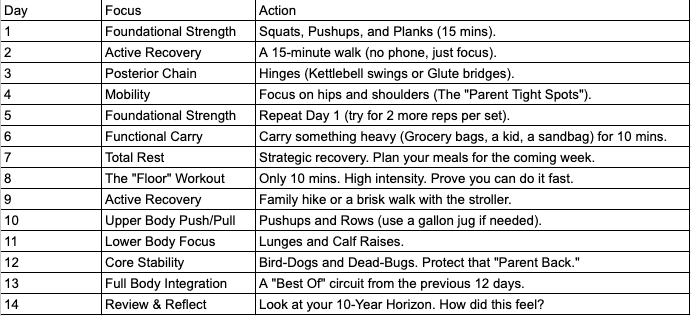
X. The 14-Day Consistency Reset: Building Your Base
Theory without action is merely entertainment. To transition from someone who relies on motivation to someone who embodies consistency, you need a “Pattern Interrupt.”
The goal of these 14 days is not to transform your physique—it is to rewire your brain. We are proving to your subconscious that you can show up for yourself, even amidst the chaos of parenting.
The Rules of the Reset
Lower the Bar: You are only required to move for 15 minutes.
Zero Negotiations: You pick a “trigger” (e.g., after the first coffee or after the kids are in bed) and you do not deviate.
The “Never Miss Twice” Rule: If a child gets sick or a meeting runs late and you miss a day, you are forbidden from missing the second day.
The 14-Day Schedule
Conclusion: The First Brick in Your Base
If you have read all 2,500 words of this guide, you already have more knowledge than 90% of the people in your local gym. But knowledge is not power; applied knowledge is power.
Motivation is a guest that visits occasionally. Consistency is the owner of the house. By choosing to build a Base of Strength today, you are making a down payment on a version of yourself that is stronger, more resilient, and more present for the people who call you “Mom” or “Dad.”
Don’t wait for the “perfect time.” The kids will always be loud, work will always be busy, and you will always be a little bit tired. Start anyway. Consistency wins long after motivation fades—and your journey starts with the next 15 minutes.